How Much Should a Notary Charge in 2026? A Complete Notary Pricing Guide to Stop Undervaluing Your Work


If you’ve ever hesitated before quoting your fee—or worse, lowered your price on the spot just to secure a booking—you’re not alone. One of the most common questions notaries ask is, “how much should a notary charge?” And the truth is, most notaries don’t undercharge because they lack skill or value. They undercharge because they don’t have a clear pricing structure.
Let’s fix that.
Pricing your notary services in 2026 isn’t about guessing, copying competitors, or “feeling it out.” It’s about building a strategy that reflects your time, your expertise, your expenses, and your long-term business goals. When your pricing is structured—not emotional—you move from surviving to actually running a sustainable business.
This guide will walk you through exactly how to build that structure.
Understand State-Regulated Fees
Before you can confidently set your pricing, you need to understand what parts of your fees are regulated—and what parts are not.
Most states set a maximum fee per notarized signature. This is non-negotiable. Whether your state allows $5, $10, or $15 per notarization, you must stay within that limit. However, that’s only one piece of your total income.
What many new notaries don’t realize is that your business doesn’t have to rely solely on notarization fees. Depending on your state, you may also be able to charge:
Travel fees
Convenience fees
Administrative or service fees
This is where your real earning potential comes into play.
For example, if your state caps notarizations at $10 per signature, you might only earn $20 from two documents—but if you’ve structured your mobile notary fees correctly, the full appointment could be worth $75, $100, or more.
The key here is compliance. Always check your specific state laws to confirm what is allowed. Your pricing should be both profitable and legally sound.
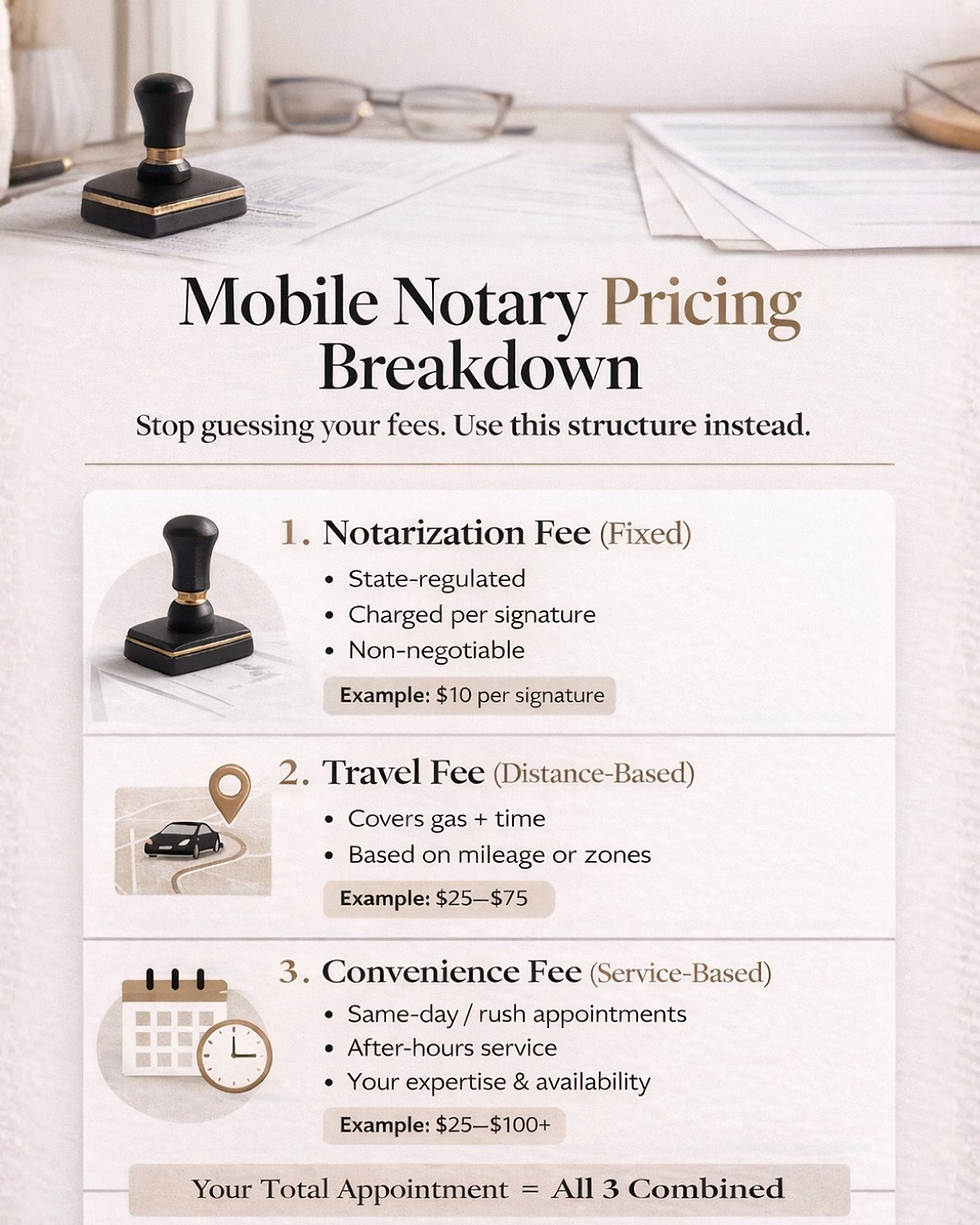
The 3-Part Mobile Notary Pricing Formula
If you’ve been wondering how to structure your fees without guessing, here’s the framework that simplifies everything. Every mobile appointment should be built on three components:
Notarization Fee
This is the state-regulated portion. It’s straightforward: you charge per notarized signature within your state’s allowed limit.
This fee reflects your commission—not your business.
Travel Fee
Your travel fee compensates you for:
Gas
Vehicle wear and tear
Time spent commuting
Opportunity cost (what you could be doing instead)
In 2026, rising fuel costs and time demands make travel fees essential—not optional. If you’re waiving travel fees, you’re essentially paying to work.
Many successful notaries structure travel fees based on distance or zones. For example, a base travel fee within 10 miles, then incremental increases beyond that.
Convenience or Administrative Fee
This is where your business truly earns.
This fee covers:
Scheduling and coordination
Client communication
Document handling
Printing (if applicable)
Expertise and professionalism
After-hours or urgent appointments
This is also the fee that reflects your brand positioning. A professional, reliable notary who shows up prepared and on time delivers convenience—and convenience has value.
When you combine these three elements, you move from “charging for a stamp” to running a service-based business.
Notary Pricing Guide: How to Structure Your Fees for Profit and Sustainability
A strong notary pricing guide isn’t just about picking numbers that “feel right.” It’s about creating a system that ensures every appointment you accept actually contributes to your income, not drains it. When your pricing is structured correctly, you stop second-guessing yourself and start operating like a true business owner.
At its core, a reliable notary pricing guide should help you account for three things: your time, your expenses, and your expertise. Every appointment you take requires more than just a stamp—it involves communication, scheduling, travel, and the responsibility of executing documents correctly. If your pricing doesn’t reflect all of that, you’re undercharging, even if you’re fully booked.
Think of your pricing as a layered structure rather than a flat fee. Your base notarization fee may be limited by state law, but your overall service price should include additional components that reflect the full scope of the job. This is especially important for mobile notaries, where travel, convenience, and time all play a significant role in the service provided.
For example, instead of quoting a single number without explanation, your notary pricing guide should allow you to confidently present a total fee that includes notarization, travel, and service time. This not only protects your income but also positions you as a professional who understands the value of your work.
The goal isn’t to be the cheapest option—it’s to be the most reliable and well-structured. Clients who value convenience and professionalism are willing to pay for a seamless experience. When your pricing reflects that level of service, you naturally attract better clients and create a more sustainable business model.
Ultimately, a well-built notary pricing guide gives you consistency. It removes the guesswork, eliminates emotional pricing decisions, and allows you to grow with confidence.
Why Notaries Undervalue Themselves
Even with a clear structure, many notaries still hesitate to charge appropriately. Let’s address why.
First, there’s the fear of losing clients. It’s easy to assume that if you charge more, people will go elsewhere. But in reality, clients looking for professionalism, reliability, and efficiency are not shopping for the cheapest option—they’re looking for the best experience.
Second, many notaries compare themselves to beginners. If someone new is charging $25 for a mobile appointment, it can create pressure to match that price. But pricing should reflect your business model—not someone else’s lack of one.
Third, there’s a lack of financial awareness. If you don’t know your monthly expenses, it’s impossible to know what you need to charge to stay profitable.
And finally, many notaries confuse affordability with professionalism. Lower prices do not automatically attract better clients—they often attract more demanding ones.
When you underprice your services, you don’t just reduce your income—you increase your workload and stress.
Calculate Your Break-Even Number (Step-by-Step)
If you’ve ever asked yourself, “how much should a notary charge to actually make money?”—this is the step that gives you clarity.
Let’s walk through a simple example.
Start with your monthly expenses. This includes both business and personal essentials:
Rent or mortgage
Utilities
Insurance
Gas
Supplies
Marketing
Phone and internet
Let’s say your total monthly expenses are $3,000.
Next, decide your desired income. Maybe you want to earn $4,000 per month.
Now combine the two:
$3,000 (expenses) + $4,000 (income) = $7,000 total needed monthly.
Now, estimate how many appointments you can realistically complete in a month. Let’s say 100 appointments.
Divide your total by your appointment volume:
$7,000 ÷ 100 = $70 per appointment
That means your minimum average appointment fee should be $70 just to meet your goals.
This number becomes your pricing baseline. Anything below it means you’re either underpaid or overworked.
This is how you move from guessing to strategic pricing.
Pricing Advanced Services
Not all notary work is priced the same—and it shouldn’t be.
As your skills grow, your pricing should reflect that.
Loan Signing Agent Pricing
Loan signings require:
Printing large document packages
Attention to detail
Knowledge of loan documents
Time-intensive appointments
Because of this, loan signing agent pricing typically ranges much higher than general notary work. Experienced signing agents often command $100–$200+ per appointment depending on complexity and location.
Estate Planning Appointments
These appointments often involve multiple documents, multiple signers, and a higher level of professionalism. Clients are typically willing to pay more for a smooth, guided experience.
Remote Online Notarization (RON)
RON introduces a completely different pricing structure. While travel is eliminated, you’re investing in:
Technology platforms
Digital certificates
Compliance tools
RON fees often include platform costs plus a service fee that reflects the convenience of completing the notarization online.
The key takeaway here is simple: your skill level increases your earning potential.
If you’re looking to expand into these higher-paying services, investing in proper training is essential. Advanced certifications and structured education can position you to confidently charge higher fees without hesitation.
How to Communicate Pricing Confidently
Even the best pricing structure won’t help if you can’t communicate it clearly.
Confidence in your pricing doesn’t come from memorizing scripts—it comes from knowing your value. But having a simple, professional response helps eliminate uncertainty.
Here’s a strong example you can use:
“My fee for that service is $___, which includes travel and appointment time. I’ll send confirmation once scheduled.”
Notice what this does:
It states the fee clearly
It includes value (not just a number)
It avoids over-explaining or apologizing
When you present your pricing with confidence, clients are far more likely to accept it without hesitation.
Pricing Mistakes to Avoid
Even experienced notaries fall into pricing traps that limit their growth.
One of the biggest mistakes is matching the cheapest competitor.
Competing on price alone turns your business into a race to the bottom—and that’s not sustainable.
Another common mistake is waiving travel fees. Every mile you drive has a cost. If you’re not charging for it, your profit margin disappears quickly.
Finally, many notaries forget to review their pricing regularly. Costs change. Demand changes. Your experience level changes. Your pricing should evolve with your business.
If you’re still charging what you charged last year without reassessing, there’s a good chance you’re underpricing today.
Stop Underpricing—Start Building a Business
Underpricing might feel like a way to stay competitive, but in reality, it leads to burnout, frustration, and inconsistent income.
Strategic pricing does the opposite.
It gives you clarity.
It gives you confidence.
And most importantly, it gives your business sustainability.
If you want to grow as a notary in 2026, your pricing needs to reflect more than just a signature—it needs to reflect your value as a professional service provider.
Notary Training Hub exists to help you build that level of professionalism, from foundational skills to advanced income streams. Whether you’re just starting or ready to scale, having the right pricing strategy is one of the most powerful shifts you can make.
Have you reviewed your pricing this year?
If not, now is the time. Take what you’ve learned here, calculate your numbers, and adjust your pricing with intention. Your future business depends on it.


Comments