Apostille Industry Updates Every Notary Needs to Know in 2026

By Amber Gist, Director of Instruction | Certified Apostille Services Facilitator Program | Notary Training Hub
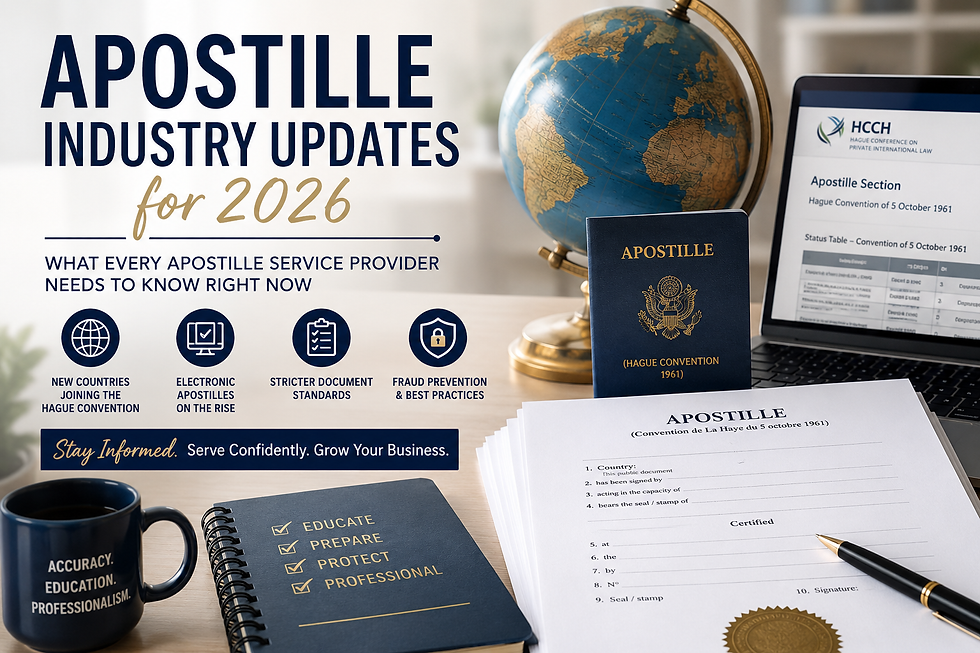
What Is the Hague Apostille Convention and Why Should Notaries Care?
The Hague Apostille Convention (formally, the 1961 Hague Convention Abolishing the Requirement of Legalization for Foreign Public Documents) is the international treaty that makes apostilles possible. When a country joins, it agrees to accept a single apostille certificate in place of the multi-step consular legalization process.
For notaries who offer apostille services, understanding which countries are members, which are not, and which have recently joined is not optional. It is the foundation of accurate client advising.
Update 1: The Hague Convention Now Has 129 Contracting Parties

As of 2026, there are 129 Contracting Parties to the Hague Apostille Convention. If you have seen older websites or social media posts still citing "120+ countries," that information is outdated. Do not share it with clients.
Here is how quickly membership has grown in recent years:
2022: Indonesia and Saudi Arabia
2023: Senegal, Pakistan, and China
2024: Rwanda and Canada
2025: Bangladesh and Algeria (acceded late 2025)
2026: Vietnam (effective September 11, 2026)
Countries Entering Force in 2026
Two countries are at critical transition stages right now, and your clients may already be asking about them.
Algeria: Algeria's accession takes effect on July 9, 2026. Until that date, documents destined for Algeria require full consular legalization, not an apostille. After July 9, a single apostille replaces the multi-step process. If a client needs documents processed for Algeria before that date, do not confuse them with apostille language.
Vietnam: Vietnam's accession takes effect on September 11, 2026. Until then, consular legalization is still required. Put this date on your calendar and communicate it clearly to any client with Vietnam-related document needs.
What About Thailand?
Thailand's Cabinet approved internal steps toward accession in December 2025, but as of now, the instrument of accession has not been officially deposited with the HCCH. Thailand is not a Hague member yet. Do not advise clients otherwise. Continue monitoring hcch.net directly for updates.
Action step: Bookmark the HCCH Status Table for Convention No. 12 at hcch.net. This is your most reliable, real-time source for country membership status. Do not rely on Google searches when advising clients on country eligibility.
Update 2: Electronic Apostilles Are the Future, and They Are Already Here

This is one of the most significant shifts in the industry right now. The HCCH continues to expand its electronic Apostille Programme, known as the e-APP, globally. Countries and U.S. states are actively moving toward digital apostilles, electronic issuance, QR code verification, and fully paperless document workflows.
What Is an e-Apostille?
An electronic apostille, or e-Apostille, is an apostille issued in electronic form with a digital signature. It is typically issued as a PDF and verified through a secure online database called an e-Register. Legally, an e-Apostille carries the same validity as a traditional paper apostille and cannot be refused simply because it is in electronic form.
Which U.S. States Are Already Issuing e-Apostilles?
The following states are currently issuing e-Apostilles or have e-Registers in place:
Kentucky, Minnesota, Washington, Connecticut, Montana, Rhode Island, and Utah.
More states are expected to follow. If your state is not on this list yet, it is coming. Start educating yourself and your clients now.
A Global Milestone: The 14th International e-APP Forum
In May 2026, the HCCH held its 14th International Forum on the electronic Apostille Programme in Marrakech, Morocco. This was the first time the forum was held on the African continent, a meaningful signal of how seriously the global community is taking digital document authentication.
What You Need to Know to Serve Clients Well
Your clients are going to encounter e-Apostilles, and many of them are going to be confused or skeptical. You need to be prepared to:
Verify a digital apostille through an e-Register
Explain e-Apostilles to clients in plain, simple language
Identify legitimate QR verification systems versus fraudulent imitations
Communicate that states and countries differ in whether they currently issue or accept e-Apostilles
Clarify that the U.S. Department of State has not yet transitioned to e-Apostille issuance at the federal level
If a client tells you an e-Apostille looks fake because there is no physical stamp, that is your opportunity to educate them. Prepare your explanation now, before you are put on the spot.
Update 3: Apostille vs. Legalization, A Distinction Your Clients Still Need Help Understanding

This is one of the most common points of confusion in the industry. Clients frequently request apostilles for countries that actually require full consular legalization, and that mistake can cause costly delays and rejections.
Here is the clear distinction to communicate every time:
Apostille: Used when the destination country is a Hague Convention member. One certificate, simpler process.
Legalization: Used when the destination country is not a Hague Convention member. Multi-step process involving state authentication, federal authentication, and embassy or consular processing.
Common Client Misconceptions to Correct Right Now
United Arab Emirates (UAE): Not a Hague member. Full embassy legalization is required, along with MOFA attestation.
Qatar: Not a Hague member. Full legalization is required.
China: China joined the Hague Convention in November 2023. Some clients may still assume China does not accept apostilles. This has changed, and clients need to know it.
Saudi Arabia: Saudi Arabia joined in 2022. Apostilles are accepted, but some agencies may request additional verification during the ongoing transition period.
One of the most important concepts to teach clients: an apostille authenticates the official signature on the document. It does not verify the content of the document as accurate or true. It confirms that the signature of the official who signed it is legitimate. That explanation alone builds significant trust and clarity with clients who are confused about what the apostille actually does.
Update 4: Fraud Is Increasing Alongside Demand
As apostille services become more popular and more searchable online, fraudulent providers are filling that space. Your clients are vulnerable, and your ability to protect them is part of your professional value.
Common Fraud Tactics in the Industry Right Now
Fake apostille websites that appear legitimate but charge for services they cannot legally provide
False claims of "same-day federal apostille" processing (this does not exist)
Forged apostille certificates presented as real
Providers charging clients for apostilles destined for countries that do not accept them
Fake embassy processing and fraudulent consular service claims
Advanced Knowledge That Separates Serious Professionals
Here is something important that is not widely discussed: some countries belong to the Apostille Convention, but bilateral objections between specific nations affect recognition. Just because two countries are both Hague members does not automatically mean their apostilles are accepted between them.
That is advanced-level knowledge, and it is the kind of detail that separates professionals who truly understand apostille services from people who are simply running documents without comprehensive training.
Always verify country participation directly through hcch.net before advising any client. Confirm whether apostille or legalization is required and understand that recognition requirements can vary even between member countries.
Update 5: Document Standards Are Getting Stricter
Apostille offices and government agencies across the country are tightening their document standards. Your clients need to understand this upfront so expectations are set correctly from the beginning.
What to Prepare Your Clients For
Stricter notarization requirements before apostille submission
Rejection of incomplete or improperly completed notarial certificates
Increased scrutiny on loose acknowledgments
Rejections caused by document date mismatches
Greater review of vital records including birth, death, and marriage certificates
The key teaching point here: the apostille authenticates the signature on the document. The document itself must be properly executed before it even reaches the apostille stage. A well-completed notarial certificate on the front end protects everyone, saves time, and reduces costly errors.
Update 6: Processing Delays Are Still a Reality
Many apostille offices continue to experience delays due to seasonal volume, staffing changes, mailing backlogs, and federal authentication slowdowns. This is not going away in the near term. How you communicate about timelines directly affects your client relationships and your reputation.
Best Practices for Managing Client Expectations
Set realistic turnaround timelines with every client, upfront and in writing
Never overpromise on timelines you cannot control
Build a client intake system and a pre-submission checklist
Educate clients on the difference between state and federal processing times
Account for mailing time in both directions when quoting timelines.
Something to keep in mind: your apostille clients are typically navigating significant life events, including immigration applications, dual citizenship, international business, adoptions, visas, study abroad programs, and international weddings. Delays hit differently when the stakes are deeply personal. Clear, honest communication is not just a business practice. It is part of the service.
Under promise and overdeliver. Every time.
Building a Thriving Apostille Business in 2026
The apostille providers who are winning right now are building relationships and consistently educating the public. Here is how to position yourself as the trusted expert in your area.
Ready to Build or Level Up Your Apostille Practice?
These updates represent just a portion of what we cover inside the Certified Apostille Services Facilitator Program at Notary Training Hub.
Our program is designed to take you from understanding the basics of apostille services to running a structured, client-ready practice with the confidence to advise accurately and serve at a high level.
If you are ready to add apostille services as a revenue stream, or you want to sharpen the foundation you already have, the program gives you the training, tools, and ongoing support to do it right.
Visit notarytraininghub.com to learn more.
Sources: hcch.net (2025-2026 News Archive), Envoy Global, Fragomen, Schmidt & Schmidt, attestationmea.com
Amber Gist is an educator, entrepreneur, and the Director of Instruction for the Certified Apostille Services Facilitator Program at Notary Training Hub. She has helped hundreds of notaries build profitable, professional service-based businesses through practical, structured education.


Comments